Coercive Control
Teaching Adolescents About Intimate Partner Violence, Coercive Control and Relational Abuse
November 26, 2026 · 14 min read · Soteldo Psychotherapy Clinic
Educational information
This article provides general education, not legal advice or an individual assessment. It does not offer child or adolescent psychotherapy through the clinic. If there is immediate danger, call 911.
A Developmentally Responsive Framework for Healthy Dating Education Beginning at Age 14
Soteldo Psychotherapy Professional Corporation · November 2026
Abstract
Adolescence is a formative period for learning how intimacy, autonomy, consent, conflict, and care operate in romantic relationships. It is also a period in which controlling behaviour may be normalized as jealousy, protection, loyalty, or proof of love. This narrative review integrates recent prevention research, Canadian surveillance data, public-health guidance, and developmental principles to propose an age-appropriate framework for teaching young people about intimate partner violence, coercive control, and patterns commonly described in public discourse as narcissistic abuse. The paper argues that education should begin before or near the onset of dating and should be universal, repeated, gender-responsive, inclusive of diverse sexual orientations and gender identities, and grounded in observable behaviours rather than personality-disorder labels. Effective teaching combines relationship literacy, consent and boundary skills, emotional regulation, digital-safety competence, critical media literacy, bystander action, disclosure response, and access to confidential support. Boys should be engaged as potential recipients of harm, supportive peers, and accountable relationship partners; girls should be supported without placing responsibility for preventing violence on them. A proposed eight-domain curriculum and a practical dating-guidance model are presented. The central conclusion is that adolescents are safest when adults teach not merely how to identify a dangerous person, but how to recognize patterns that restrict autonomy, practise mutuality, respond to early warning signs, and seek help without shame.
Keywords
adolescent dating violence; coercive control; healthy relationships; consent; psychological abuse; technology-facilitated abuse; prevention; youth education
Introduction
Young people do not enter dating relationships with a fully formed map of intimacy. Their expectations are shaped by family relationships, peers, pornography, entertainment, social media, gender norms, and early experiences of belonging. At approximately age 14, many adolescents are beginning to explore romantic interest while still developing executive functioning, emotion regulation, future-oriented judgment, and resistance to peer pressure. Prevention education at this stage is therefore not premature. It is anticipatory guidance delivered before unhealthy patterns become entrenched.
The need is substantial. Canadian self-report data indicate that 45% of adolescents aged 15 to 17 who had been in a dating relationship since age 15 reported some form of dating abuse or violence; emotional abuse was the most prevalent form (Sutton & Burczycka, 2024). These findings do not imply that all experiences are identical in severity, context, or impact. They do demonstrate that education limited to assault prevention will miss much of what adolescents experience. Psychological aggression, monitoring, humiliation, sexual pressure, threats, isolation, and technology-enabled surveillance can create a climate of fear and dependency even in the absence of physical force.
This article addresses two questions: What should adolescents be taught about intimate partner violence and coercive control beginning at age 14, and how should adults guide young people through dating without replacing education with surveillance? It also considers the popular term narcissistic abuse. Although the term may help some survivors name patterns of manipulation, it is not a formal diagnostic category. Prevention education should describe behaviours and impacts and should not encourage adolescents to diagnose peers with narcissistic personality disorder.
Conceptual Foundations
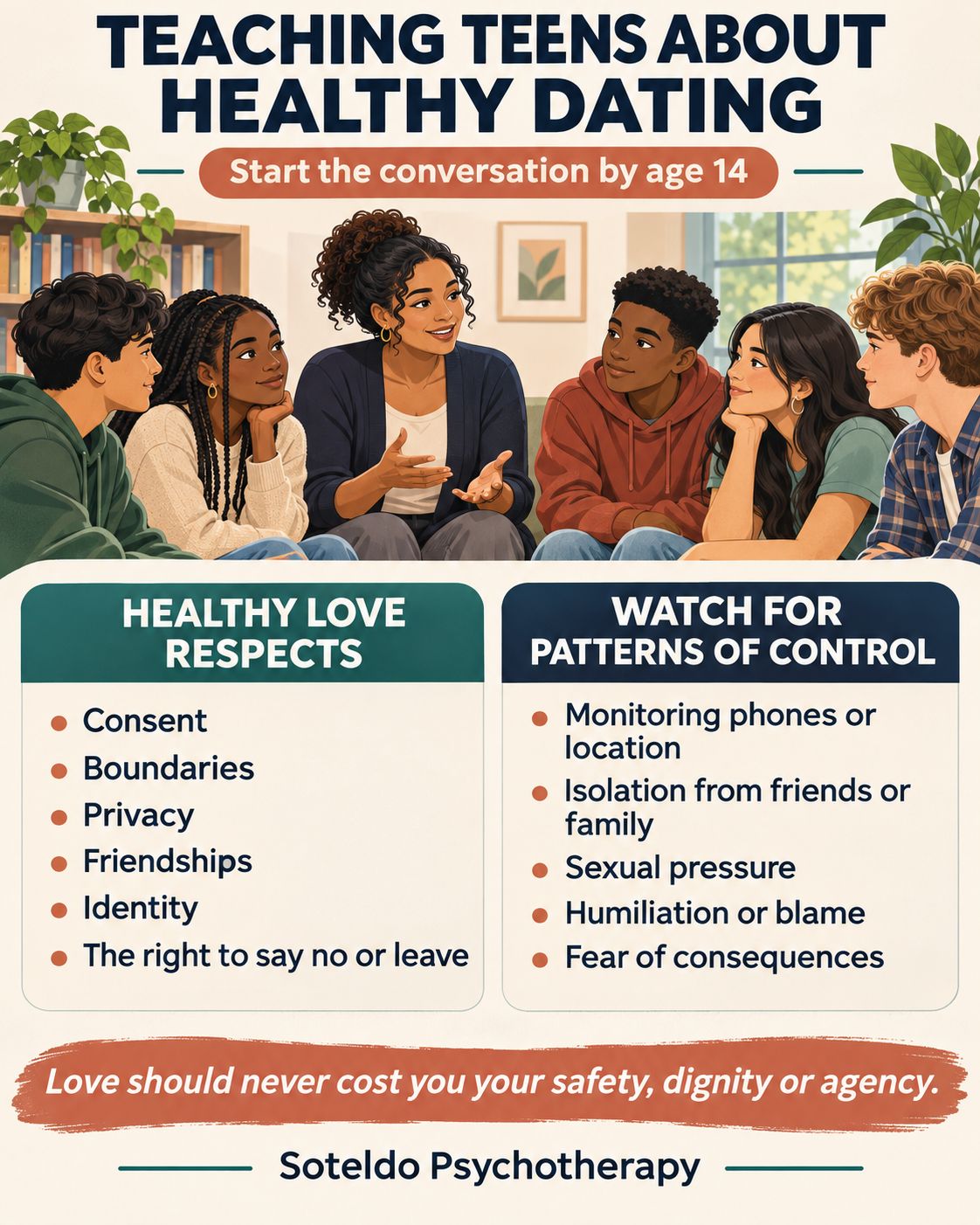
Teen dating violence includes physical, sexual, psychological, and technology-facilitated harm within current or former dating relationships. Coercive control is better understood as a patterned restriction of another person’s autonomy than as a single argument or isolated unkind act. Its elements may include monitoring, isolation, intimidation, threats, sexual coercion, economic restriction, regulation of clothing or friendships, forced password access, location tracking, punishment for delayed replies, and alternating affection with degradation. The key questions are not only what happened, but whether a pattern is developing, whose freedom is shrinking, what consequences follow resistance, and whether fear organizes the relationship.
Adolescent education must also distinguish conflict from abuse. Conflict occurs in healthy relationships and may involve strong emotions or poor communication. Abuse involves entitlement, domination, coercion, retaliation, exploitation, or a repeated disregard for the other person’s consent and dignity. Harm may be bidirectional in some relationships, but apparent symmetry in isolated acts does not establish equivalence in motive, pattern, fear, injury, or control. Contextual assessment remains essential.
The phrase narcissistic abuse should be handled carefully. Features often associated with it—idealization followed by devaluation, chronic blame shifting, humiliation, gaslighting, exploitation, intermittent reinforcement, image management, and lack of accountability—can be taught as relational warning signs. However, these behaviours do not prove a personality disorder, and a diagnosis cannot be responsibly made from social-media content or a partner’s report alone. Behaviour-based language is clearer, less stigmatizing, and more actionable: “They pressure you to give up friends” is more useful than “They are a narcissist.”
Why Education Should Begin by Age 14
Prevention is most useful when it precedes exposure and is revisited as adolescents gain new experiences. The Centers for Disease Control and Prevention’s Dating Matters model begins with youth aged 11 to 14 and combines strategies directed at young people, peers, families, schools, and neighbourhoods (Centers for Disease Control and Prevention [CDC], 2024a). This timing recognizes that healthy-relationship capacities can be developed before serious dating begins.
Meta-analytic evidence supports structured prevention while also cautioning against overclaiming. Across 18 randomized trials involving 22,781 adolescents, interventions were associated with reductions in combined physical and sexual dating violence, with clearer effects for physical violence than sexual violence (Piolanti & Foran, 2022a). A separate meta-analysis found small but significant reductions in psychological dating-violence victimization and perpetration and suggested stronger effects for multilevel programs spanning home, school, and community contexts (Piolanti & Foran, 2022b). School-based evidence remains heterogeneous and frequently low in certainty, but relationship-violence outcomes appear more responsive than broader gender-based violence outcomes (Farmer et al., 2023). Thus, a single assembly is insufficient; prevention should be developmentally sequenced, practised, reinforced, and connected to institutional policy and support.
A Gender Responsive and Inclusive Approach
Girls and boys both require education, but identical messaging can obscure gendered patterns of power and the different social pressures young people face. Girls may be taught to equate jealousy with devotion, to manage a partner’s emotions, or to avoid seeming rude. Education should explicitly affirm their right to privacy, bodily autonomy, friendships, ambition, disagreement, and exit. It must not imply that sufficient vigilance can prevent another person’s abuse. Responsibility belongs to the person choosing coercive or violent behaviour and to adults and institutions responsible for safety.
Boys should not be addressed only as possible perpetrators. They may experience abuse, sexual coercion, humiliation, stalking, or digital exploitation and may fear disbelief. They should also be invited into accountable masculinity: emotional literacy, acceptance of rejection, non-retaliation, respect for consent, peer intervention, and help-seeking. Shame-based teaching can create defensiveness; accountability-based teaching makes expectations concrete and insists that harm be repaired and stopped.
Programs must include LGBTQ+ and gender-diverse youth without treating heterosexual couples as the default. Examples should vary pronouns and relationship forms and address threats of outing, identity-based degradation, isolation from affirming communities, and control of gender expression or health care. Inclusive education benefits all students because it teaches principles rather than scripts tied to one gender configuration.
Eight Domains for an Adolescent Curriculum
1. Relationship rights and mutuality. Adolescents should be able to state that each partner retains a separate identity, friendships, privacy, goals, beliefs, and the right to end a relationship. Healthy closeness expands rather than steadily contracts a person’s life.
2. Consent as an ongoing process. Consent should be taught as voluntary, informed, specific, reversible, and communicated without fear. Prior agreement, dating status, gifts, persistence, silence, intoxication, or an intimate image previously shared do not create continuing permission. Students should practise asking, checking, hearing no, stopping, and responding to changed consent without sulking, threats, or retaliation.
3. Boundaries and responses to boundaries. A boundary identifies what a person will or will not participate in; it is not a tool for controlling someone else. The partner’s response is diagnostically informative at the behavioural level. Respect, curiosity, and negotiation differ from ridicule, repeated testing, punishment, public embarrassment, threats of self-harm, or withdrawal used to force compliance.
4. Coercive-control pattern recognition. Students can learn a simple pattern test: Is the behaviour repeated? Does it restrict freedom? Is there a threatened or actual consequence for resistance? Is the young person becoming afraid, isolated, confused, or hypervigilant? Teaching should include low-visibility examples such as clothing rules, “prove you love me” demands, access to accounts, accusations for ordinary social contact, pressure to leave activities, and manufactured crises that keep attention centred on one partner.
5. Emotional and psychological abuse. Instruction should name humiliation, insults, threats, gaslighting, blame shifting, silent treatment used as punishment, public-private personality shifts, destruction of valued items, and cycles of intense affection followed by devaluation. Students should learn that apologies matter only when accompanied by responsibility, changed behaviour, respect for consequences, and sustained repair.
6. Digital and sexual safety. Adolescents need concrete guidance about passwords, device access, location sharing, disappearing messages, intimate images, impersonation, account takeover, repeated unwanted contact, and AI-generated sexual imagery. No technical feature can guarantee that an intimate image will remain private. Education should avoid shaming a young person who shared an image and should clearly assign responsibility for coercive requests or non-consensual distribution to the person causing the harm.
7. Emotional regulation and relationship skills. Prevention must teach what to do, not only what to avoid. Skills include tolerating disappointment, pausing during escalation, expressing needs without threats, recognizing physiological arousal, repairing harm, negotiating differences, managing jealousy, and accepting a breakup. Role-play and behavioural rehearsal make these capacities usable under stress.
8. Help-seeking, bystander action, and safety. Students should identify several trusted adults and confidential or anonymous services. They should practise how to respond when a friend discloses: believe them, avoid interrogation, assess immediate danger, preserve their choices where possible, and connect them with support. Bystanders should not confront a potentially dangerous partner if doing so could escalate risk. Adults must explain limits of confidentiality before disclosure whenever possible.
Guiding Adolescents Through Dating
Guidance should function as a scaffold rather than a surveillance system. Excessive monitoring may teach concealment and can imitate the control adults want adolescents to recognize. A more effective model combines connection, preparation, calibrated independence, and reliable support.
Before dating, adults can establish an open-door relationship and discuss values, rights, consent, digital safety, transportation, substance use, and what help would look like. Rules should be explained and proportionate, not based on gendered double standards. Teens should know that asking for help will not automatically result in punishment or total loss of privacy.
During dating, adults can use brief, ordinary questions rather than interrogation: “Do you feel like yourself around this person?” “Can you disagree without being punished?” “Are you still seeing your friends?” “What happens when either of you says no?” “Does your phone feel like your own?” and “Is anything making you feel rushed, afraid, or responsible for keeping them calm?” Conversation can begin with a television plot, song, or social-media scenario, which reduces pressure and supports critical reflection (Women and Gender Equality Canada, 2026).
Practical safety scaffolding may include a charged phone, an agreed check-in, independent transportation, a code word, a trusted adult who can pick the teen up without immediate questioning, and knowledge of where to seek help. These measures should be framed as normal supports available to everyone, not as evidence that the adolescent is incapable of judgment.
After dates or conflicts, adults should invite reflection rather than demand a verdict: What felt good? What felt uncomfortable? Were your limits respected? Did you feel free to change your mind? What would you want a friend to notice in the same situation? This develops discernment and helps adolescents integrate experience with principles.
Teaching Methods
Didactic information is necessary but insufficient. Effective learning should include developmentally realistic scenarios, anonymous question submission, role-play, peer-norm correction, media analysis, repeated practice, and opportunities to identify local supports. Scenarios should begin with ambiguous early warning signs and show escalation over time so students learn to recognize patterns before severe violence occurs. They should also portray healthy disagreement, respectful breakups, repair, and accountable peer intervention.
Educators should use trauma-informed facilitation. Content warnings, opt-out pathways, private follow-up options, predictable procedures, and non-graphic language reduce unnecessary exposure. No student should be asked to disclose personal experiences publicly or enact a victim or aggressor role that feels unsafe. Facilitators must be prepared for disclosures and know relevant child-protection duties, school policies, and referral pathways. Canadian federal guidance recommends transparency about confidentiality and reporting obligations and preserving a young person’s choices wherever possible (Women and Gender Equality Canada, 2026).
A whole-school model aligns classroom content with staff training, clear reporting pathways, responses to harassment, digital conduct policies, caregiver education, and access to culturally responsive services. Mixed-gender learning can establish shared norms, while occasional affinity-based groups may create space to examine gender-specific pressures. Youth should participate in curriculum design, language selection, accessibility review, and evaluation.
Responding to a Disclosure
The first adult response can influence whether a young person seeks further help. A helpful sequence is: listen without pressing for a complete chronology; thank the young person for telling; affirm that coercion or violence is not their fault; ask about immediate safety, injuries, threats, stalking, sexual harm, weapons, strangulation, and threats of suicide or homicide when clinically indicated; explain confidentiality limits; offer choices; and arrange follow-up. Adults should avoid demanding an immediate breakup. Separation can increase danger in some abusive relationships, and a forced prohibition may drive the relationship underground.
Safety planning should be individualized. It may address school transitions, transportation, account security, evidence preservation, supportive peers, safe adults, emergency contacts, and how to manage shared classes or activities. If intimate images are involved, adults should avoid copying or redistributing them and should obtain specialized legal or child-protection guidance. When there is immediate danger, emergency services or an appropriate crisis response may be necessary. A disclosure that a young person has used harm also requires safety, accountability, assessment of context, and intervention rather than humiliation or minimization.
Implementation and Evaluation
A recommended minimum is a sequenced curriculum delivered across several sessions, reinforced annually, and paired with caregiver and staff components. Evaluation should measure more than knowledge. Outcomes should include consent communication, boundary efficacy, acceptance of controlling behaviour, bystander confidence, help-seeking knowledge, digital-safety practices, perpetration, victimization, school climate, and unintended effects. Anonymous student feedback is essential. Measures should distinguish isolated acts from patterned coercion and attend to fear, autonomy restriction, context, and impact.
Programs should be adapted with—not merely for—racialized, Indigenous, newcomer, disabled, rural, and LGBTQ+ youth. Adaptation should preserve core mechanisms such as skills practice, norm change, adult support, and institutional accountability. Implementation must also recognize structural factors, including poverty, transportation, housing instability, racism, ableism, and limited access to confidential services, which can constrain an adolescent’s choices.
Discussion
Early adolescent relationship education is most defensible when it avoids two extremes: silence until a crisis occurs and intrusive adult control presented as protection. The evidence favours multilevel prevention that begins early, teaches concrete skills, involves caregivers, and is sustained over time. Psychological and coercive behaviours deserve central attention because they are common, may precede or accompany other violence, and are easily romanticized.
The language used matters. Label-centred teaching may give adolescents a memorable villain but can reduce complex assessment to amateur diagnosis. Behaviour-centred teaching offers a better clinical and educational route. It directs attention to consent, freedom, fear, retaliation, repair, and impact; it also applies whether the person causing harm has a mental disorder, no disorder, or an unknown history.
This framework has limitations. It is a narrative synthesis rather than a systematic review, and the prevention literature varies in outcome definitions, program intensity, follow-up, population, and certainty. Evidence is stronger for some physical and psychological outcomes than for sexual violence, coercive-control trajectories, or long-term implementation. Future research should evaluate measures that capture autonomy restriction and technology-facilitated patterns, examine differential effects across identities, and involve adolescents in defining meaningful outcomes.
Conclusion
Teaching adolescents about intimate partner violence at age 14 should not be a fear-based lesson about dangerous strangers or a checklist for diagnosing narcissists. It should be a sustained education in relational freedom. Young people need language for consent, coercion, boundaries, mutuality, digital privacy, emotional regulation, accountability, and help-seeking. They need adults who remain connected without becoming controlling and institutions that respond competently when harm is disclosed. The practical goal is not to eliminate every painful dating experience. It is to reduce violence, shorten the time between concern and support, strengthen adolescents’ capacity to recognize shrinking autonomy, and establish that affection never creates an entitlement to another person’s body, attention, passwords, friendships, or future.
Practical Teaching Matrix
Domain — Teach — Practise — Adult role
Consent — Voluntary, specific, reversible agreement — Ask, check, stop, accept no — Model respect for changed decisions
Boundaries — Physical, emotional, digital, sexual, and time limits — State a limit and respond respectfully — Avoid punishment for help-seeking
Coercive control — Patterns that reduce autonomy through consequences — Identify restriction, retaliation, fear, and isolation — Ask about patterns and safety
Digital safety — Passwords, tracking, images, impersonation, repeated contact — Use privacy settings and safe evidence preservation — Support without shaming
Conflict skills — Regulation, repair, jealousy, rejection, breakup — Pause, communicate, take responsibility — Teach accountability, not humiliation
Help-seeking — Trusted adults, services, emergency options — Make and rehearse a support plan — Explain confidentiality limits
References
Centers for Disease Control and Prevention. (2024a). Dating Matters: Strategies to promote healthy teen relationships. https://www.cdc.gov/intimate-partner-violence/php/datingmatters/
Centers for Disease Control and Prevention. (2024b). Teen dating violence. https://www.cdc.gov/intimate-partner-violence/about/about-teen-dating-violence.html
Farmer, C., Shaw, N., Rizzo, A. J., Orr, N., Chollet, A., Hagell, A., Rigby, E., Young, H., Berry, V., Bonell, C., & Melendez-Torres, G. J. (2023). School-based interventions to prevent dating and relationship violence and gender-based violence: Systematic review and network meta-analysis. American Journal of Public Health, 113(3), 320–330. https://doi.org/10.2105/AJPH.2022.307153
Foshee, V. A., Bauman, K. E., Ennett, S. T., Linder, G. F., Benefield, T., & Suchindran, C. (2004). Assessing the long-term effects of the Safe Dates program and a booster in preventing and reducing adolescent dating violence victimization and perpetration. American Journal of Public Health, 94(4), 619–624. https://doi.org/10.2105/AJPH.94.4.619
Little, M. T., Butchart, A., Massetti, G. M., Hermosilla, S., Wittesaele, C., Pearson, I., Jochim, J., Swingler, S., Schupp, C., Böhret, I. A., Neelakantan, L., Backhaus, S., Martin, M., Mase, M., Page, S., Janowski, R., Blackwell, A., Bernstein, K. T., Rakotomalala, S., & Cluver, L. (2025). Interventions to prevent, reduce, and respond to violence against children and adolescents: A systematic review of systematic reviews to update the INSPIRE framework. The Lancet Child & Adolescent Health. Advance online publication. https://pubmed.ncbi.nlm.nih.gov/41213289/
Piolanti, A., & Foran, H. M. (2022a). Efficacy of interventions to prevent physical and sexual dating violence among adolescents: A systematic review and meta-analysis. JAMA Pediatrics, 176(2), 142–149. https://doi.org/10.1001/jamapediatrics.2021.4829
Piolanti, A., & Foran, H. M. (2022b). Psychological violence in dating relationships among adolescents: A systematic review and meta-analysis of prevention programs. Preventive Medicine, 159, 107053. https://doi.org/10.1016/j.ypmed.2022.107053
Sutton, D., & Burczycka, M. (2024). Dating violence against teens aged 15 to 17 in Canada, 2009 to 2022. Statistics Canada. https://www150.statcan.gc.ca/n1/pub/85-002-x/2024001/article/00004-eng.htm
Women and Gender Equality Canada. (2026). Gender-based violence conversation guide for adults supporting teens 14 to 18. Government of Canada. https://www.canada.ca/en/women-gender-equality/campaigns/gender-based-violence-its-not-just/resources-adults/gender-based-violence-conversation-guide-for-adults-supporting-teens-14-to-18.html
World Health Organization. (2025). RESPECT women: Preventing violence against women (2nd ed.). https://www.who.int/publications/i/item/9789240117020
You don't have to figure this out alone.
Soteldo Psychotherapy Clinic specializes in narcissistic abuse recovery, coercive control, and high-conflict relational trauma. Book a free 15-minute consultation with Raquel Soteldo, RP.
Book a 15-min meeting with RaquelLooking for self-paced survivor courses and recorded resources? Visit our Linktree.