Coercive Control
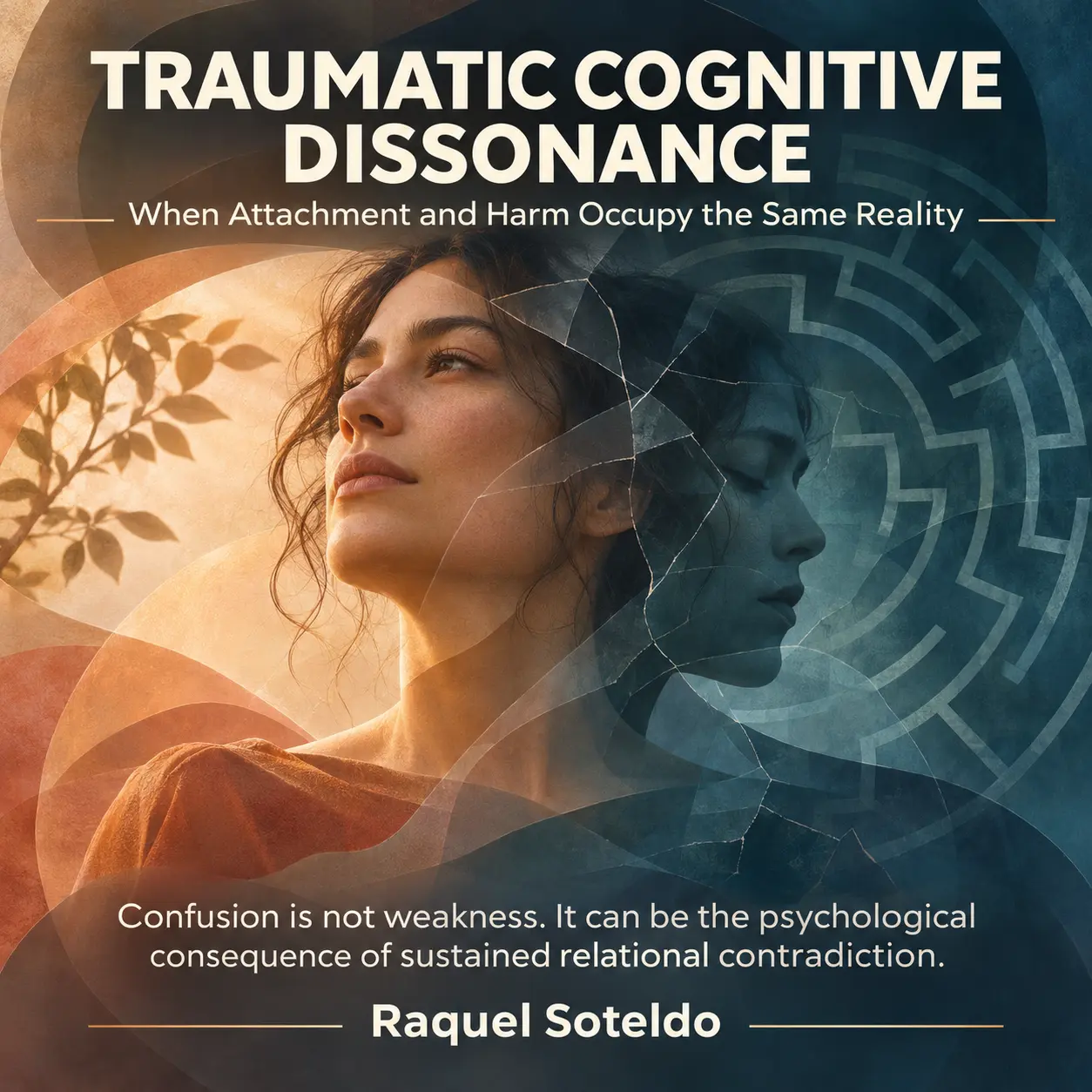
Traumatic Cognitive Dissonance in Relational Trauma
November 26, 2026 · 11 min read · Soteldo Psychotherapy Clinic
Educational information
This article is general education, not a diagnosis or a substitute for individual psychotherapy. If you are in immediate danger, call 911.
Abstract
Cognitive dissonance describes the psychological discomfort that arises when beliefs, experiences, values, or actions are incompatible. In coercive, deceptive, or psychologically abusive relationships, this ordinary process may become chronic and trauma-laden. A person may be required to hold mutually incompatible realities: the partner is loving and dangerous, remorseful and repetitive, protective and controlling. This article uses traumatic cognitive dissonance as a proposed descriptive construct—not a formal diagnosis—to explain the confusion, self-doubt, fragmented meaning-making, and impaired decisional confidence that may follow sustained relational contradiction. It distinguishes survivor dissonance from the self-protective cognitive processes of a harm-doing individual who may be egocentric, low in introspective capacity, or resistant to learning from experience. The article also clarifies that idiocentricity is a cultural-psychological term for an individual-oriented self-construal and should not be used as a synonym for pathology, selfishness, or lack of empathy. An integrative trauma-informed framework is proposed in which recovery depends on safety, coherent chronology, restoration of epistemic trust, and values-based agency, while behavioural change in the person causing harm requires specific accountability, meaningful consequences, reflective capacity, and sustained evidence of changed conduct.
Keywords
cognitive dissonance; coercive control; psychological abuse; trauma; gaslighting; egocentrism; insight; accountability
Introduction
Cognitive dissonance theory proposes that inconsistency among cognitions produces psychological discomfort and motivates efforts to reduce the inconsistency (Festinger, 1957). In ordinary life, dissonance may be resolved by changing behaviour, revising a belief, seeking new information, or reframing the meaning of an event. In a harmful intimate relationship, however, the contradictions may be neither minor nor freely resolvable. The same person may offer affection and intimidation, apology and repetition, promises of safety and acts that undermine safety. Dependency, attachment, fear, financial restriction, parenting responsibilities, social pressure, and intermittent reinforcement can make straightforward resolution impossible.
This article develops traumatic cognitive dissonance as a clinically useful descriptive formulation for sustained, trauma-linked contradiction. The term does not appear as a diagnosis in the DSM-5-TR or ICD-11 and should not be represented as an established disorder. Its value lies in naming a process: repeated contradiction occurs under conditions of threat, dependency, betrayal, or coercion; ordinary dissonance-reduction strategies become survival adaptations; and the affected person’s confidence in memory, interpretation, and judgment may deteriorate. Coercive control is associated with posttraumatic stress and depression, supporting the need to understand its psychological effects beyond isolated incidents (Lohmann et al., 2024).
From Cognitive Dissonance to Trauma Laden Confusion
The central contradiction in abusive or coercive relationships is often not simply between two opinions. It may be between attachment and danger, stated intentions and observable conduct, or the relationship’s public image and its private reality. Victim-survivors may minimize an event, accept blame, search for exceptional explanations, focus on periods of kindness, or continually update their self-concept to preserve hope. These responses can reduce distress temporarily and may help a person function when leaving, confronting, or naming the abuse would increase danger.
Research on intimate partner aggression describes how people may reinterpret or minimize aggression to reconcile the expectation of a loving relationship with harmful conduct (Eckstein et al., 2018). Emerging work also conceptualizes coercive control trauma as harm shaped by repeated threat and restraint rather than by a single event alone (Kassing & Collins, 2026). The resulting confusion is therefore not evidence of low intelligence, weakness, or consent. It may reflect the cognitive burden of trying to preserve attachment, anticipate danger, and maintain a workable reality while receiving incompatible information.
Trauma intensifies this process. Heightened arousal can narrow attention toward immediate safety cues; dissociation can interrupt continuity of experience; sleep disruption can affect concentration and recall; and shame can bias interpretation toward self-blame. When the other person repeatedly denies events, changes explanations, attacks the survivor’s credibility, or reframes resistance as wrongdoing, the survivor may lose confidence not only in a particular memory but also in the legitimacy of knowing what they know. Confusion becomes relationally produced and maintained.
Epistemic Injury and the Loss of Self Trust
A particularly consequential effect is epistemic injury: damage to confidence in one’s capacity to perceive, interpret, remember, and communicate experience. The person may ask, “Did it really happen that way?” “Am I overreacting?” or “Why can everyone else see a different version of this person?” This uncertainty is often reinforced when individual incidents are examined without their cumulative pattern.
Traumatic cognitive dissonance can therefore be understood as a conflict among at least four forms of knowledge: observed behaviour, the partner’s explanation, the survivor’s attachment-based hopes, and the body’s threat response. The body may register danger while the mind searches for a nonthreatening account. A promise of change may temporarily restore coherence, only for repetition to reopen the contradiction. Over time, decisions can become slower, reassurance-seeking may increase, and the person may rely heavily on the harm-doing individual to interpret the very reality that the individual has destabilized.
Intermittent maltreatment and power differences have long been associated with persistent attachment after abusive relationships (Dutton & Painter, 1993). More recent findings link traumatic bonding with posttraumatic stress symptoms and identify attachment insecurity and childhood maltreatment as relevant vulnerability factors, without implying that victim-survivors cause or choose the abuse (Casassa et al., 2023).
Egocentrism Without Introspection
The person causing harm may appear highly focused on the self yet strikingly unable or unwilling to examine the self. These are not contradictory qualities. Egocentrism concerns the privileging of one’s own viewpoint, needs, injuries, or entitlement; introspection requires curiosity about one’s internal motives, emotional states, contradictions, and impact on others. A person may think about the self constantly while engaging in very little accurate self-reflection.
This distinction matters clinically and legally. Self-reference is not self-awareness. Repeated explanations about being misunderstood, disrespected, provoked, or unfairly treated may organize experience around the person’s grievance while excluding the other person’s subjectivity. Defensive processes—denial, externalization, rationalization, minimization, selective memory, and blame shifting—can protect a preferred self-image. When confrontation threatens that self-image, the response may be counterattack, victim positioning, superficial compliance, or strategic apology rather than genuine reflection.
None of these patterns, standing alone, establishes narcissistic, antisocial, psychopathic, or any other personality disorder. Responsible formulation should describe observable conduct and its effects, assess patterns across contexts and time, and avoid diagnosing an absent person. Terms such as narcissistic or psychopathic should not substitute for evidence of coercion, deception, intimidation, exploitation, stalking, violence, or repeated boundary violation.
A Note on Idiocentricity
Idiocentricity has a specific meaning in cross-cultural psychology. It generally refers to an individual-level orientation toward autonomy, personal goals, and an independent self-construal, contrasted with allocentricity, which emphasizes group goals and interdependence (Triandis et al., 1985). It is not equivalent to egocentrism, lack of conscience, poor insight, selfishness, or inability to learn.
If the intended concept is a rigidly self-centred mode of interpretation, more precise terms include egocentric perspective-taking, self-serving attribution, entitlement, externalization of responsibility, impaired reflective functioning, or limited insight. Precision prevents a cultural construct from being pathologized and keeps the analysis tied to demonstrable psychological processes.
Why Experience Alone May Not Produce Learning
Experience does not automatically become learning. Learning from relational consequences requires the capacity to encode feedback accurately, tolerate shame or guilt without collapsing into defensiveness, recognize another person as a separate subject, accept causal responsibility, and revise future behaviour. If adverse outcomes are consistently attributed to others, each consequence can be incorporated into the existing belief system without producing change. A separation becomes proof of betrayal; a boundary becomes an attack; a complaint becomes persecution; another person’s fear becomes oversensitivity.
This helps explain why repeated conversations, emotional appeals, or additional empathy may fail to alter entrenched harmful conduct. The information is not necessarily absent. It may be filtered through a system organized to protect entitlement, status, access, or a preferred identity. Confrontation can interrupt this system, but confrontation alone is not synonymous with learning. It may produce short-term compliance, impression management, retaliation, or a better-rehearsed account.
Meaningful learning is more likely when feedback is specific, consequences are predictable and proportionate, responsibility cannot be displaced, and change is measured behaviourally over time. Genuine change is shown through sustained respect for boundaries, reduced controlling behaviour, transparent repair, tolerance of another person’s independent reality, and consistency when there is no immediate reward or surveillance. It is not established by insight language, remorseful affect, a single apology, or promises made under threat of loss.
The Role of Confrontation and Accountability
Confrontation must be defined carefully. In coercive relationships, direct confrontation by the victim-survivor may increase danger and should never be presented as a therapeutic obligation. Accountability may instead occur through boundaries, reduced access, documentation, structured professional intervention, workplace or institutional processes, court orders, or other lawful consequences. Safety planning should precede any action likely to threaten the controlling person’s access or self-image.
For treatment of a person who has caused harm, productive confrontation is specific rather than shaming. It identifies the behaviour, its context, its impact, the person’s justifications, and the required alternative. The clinician should monitor whether therapy language is being used to evade responsibility or gain credibility. Progress should be judged through collateral and behavioural evidence where ethically and legally appropriate, not solely by the client’s self-report.
Accountability and empathy are not opposites. Empathic practice can acknowledge developmental history, trauma, insecurity, or shame without converting explanation into exoneration. A trauma history may illuminate vulnerability; it does not remove responsibility for coercive or abusive choices.
Clinical Implications for Survivor Recovery
Treatment should first reduce danger and cognitive overload. Pressuring a person to adopt a definitive label, leave immediately, confront the other person, or recount trauma intensively may reproduce loss of agency. A phased approach can support safety, stabilization, coherent meaning-making, and restored choice.
First, clinicians can validate the confusion without confirming facts they cannot independently know. Language such as “It makes sense that inconsistent experiences would make it difficult to know what to trust” acknowledges the process while maintaining clinical limits. Second, pattern mapping can place incidents, apologies, promises, escalation, and consequences on a chronology. This moves attention from isolated explanations to repeated sequences. Third, clinicians can distinguish observations from interpretations: what was said or done, what meaning was assigned, what bodily response occurred, and what followed. Fourth, values and boundaries can be clarified without requiring certainty about the other person’s diagnosis or motives.
Grounding, sleep support, emotion-regulation work, and treatment of posttraumatic symptoms may improve the cognitive conditions needed for decision-making. Documentation should use the client’s report, direct quotations when relevant, and observable clinical effects. Couple therapy or mediation may be inappropriate where coercive control, fear, retaliation, or inability to negotiate freely is present; careful IPV and power-imbalance screening is essential.
Legal and Forensic Implications
Legal systems often reward linear narratives, consistent recall, prompt disclosure, and decisive action. Trauma-related confusion may produce the opposite: delayed recognition, fragmented chronology, ambivalence, continued contact, recantation, or apparently inconsistent accounts. These features should not automatically be interpreted as proof that harm did not occur. At the same time, trauma-informed practice must not presume that every inconsistency confirms trauma or abuse. The appropriate response is careful, corroboration-sensitive assessment of the pattern, context, and alternative explanations.
Professionals should distinguish clinical formulation from factual adjudication. A therapist may document reported experiences, symptoms, functioning, safety concerns, and treatment without offering unsupported opinions about an absent person’s diagnosis, credibility, or legal intent. Courts and family-law processes benefit when assessors examine cumulative patterns, restrictions on autonomy, post-separation conduct, and the practical conditions under which choices were made, rather than evaluating each event in isolation.
A Proposed Integrative Model
The proposed model contains two interacting pathways. In the survivor pathway, repeated relational contradiction under threat or dependency produces dissonance; dissonance-reduction strategies preserve attachment or immediate safety; repeated invalidation weakens epistemic trust; and trauma symptoms further compromise integration and decision confidence. Recovery proceeds through safety, pattern recognition, stabilization, validation, and restored agency.
In the harm-doer pathway, egocentric interpretation and defensive self-protection reduce accurate processing of interpersonal feedback. Consequences are externalized, so experience fails to revise the underlying model. Change becomes more plausible when accountability is unavoidable, reflection is sufficiently tolerated, the other person’s subjectivity is recognized, and new behaviour is reinforced and sustained. The pathways are asymmetrical: the survivor’s confusion is an adaptation to incompatible realities under constraint, whereas the harm-doer’s resistance may function to preserve power, entitlement, access, or self-image. They should not be framed as equal communication failures.
Research Directions
Research should test whether traumatic cognitive dissonance adds explanatory value beyond established constructs such as posttraumatic stress, betrayal trauma, traumatic bonding, dissociation, gaslighting, and coercive control. Measures would need to assess contradiction under dependency or threat, instability in self-trust, dissonance-reduction strategies, and functional effects on decisions and recall. Longitudinal designs could determine whether safety and distance reduce dissonance and whether restored epistemic trust predicts recovery.
Research on individuals who cause harm should separate reflective language from reflective capacity and behavioural change. Useful outcomes include respect for boundaries, reduction in coercive acts, acceptance of responsibility, response to loss of control, and maintenance of change across settings. Cultural research is also necessary so that independent self-construal is not confused with pathological self-focus and collective norms are not romanticized when they reinforce silence or dependency.
Conclusion
Traumatic cognitive dissonance offers a useful descriptive lens for the profound confusion that can develop when attachment, danger, hope, betrayal, and coercion coexist. The construct should be used cautiously: it is not a formal diagnosis, and it should complement rather than replace established trauma and IPV frameworks. Its central contribution is to relocate confusion from presumed personal deficiency to the psychological demands of surviving incompatible realities.
The corresponding distinction between egocentrism and introspection is equally important. A person can be intensely self-focused yet unable to examine the self accurately, recognize another person’s reality, or learn from consequences that are continually externalized. Confrontation may interrupt denial, but only sustained accountability, reflective capacity, and observable behavioural change demonstrate learning. For survivors, the therapeutic task is not to force certainty. It is to restore safety, coherence, self-trust, and freedom of choice.
References
Casassa, K., Knight, L., & Mengo, C. (2023). Risk factors for traumatic bonding and associations with PTSD symptoms: A moderated mediation. Child Abuse & Neglect, 145, 106412. https://doi.org/10.1016/j.chiabu.2023.106412 Dutton, D. G., & Painter, S. L. (1993). Emotional attachments in abusive relationships: A test of traumatic bonding theory. Violence and Victims, 8(2), 105–120.
Eckstein, J. J., et al. (2018). Cognitive reframing of intimate partner aggression: Social and contextual influences. Trauma, Violence, & Abuse, 21(4), 720–734. https://doi.org/10.1177/1524838018795010 Festinger, L. (1957). A theory of cognitive dissonance. Stanford University Press.
Kassing, K., & Collins, A. (2026). Slowly, over time, you completely lose yourself: Conceptualizing coercive control trauma in intimate partner relationships. Journal of Interpersonal Violence. https://doi.org/10.1177/08862605251320998 Lohmann, S., Cowlishaw, S., Ney, L., O’Donnell, M., & Felmingham, K. (2024). The trauma and mental health impacts of coercive control: A systematic review and meta-analysis. Trauma, Violence, & Abuse, 25(1), 630–647. https://doi.org/10.1177/15248380231162972 Triandis, H. C., Leung, K., Villareal, M. J., & Clack, F. L. (1985). Allocentric versus idiocentric tendencies: Convergent and discriminant validation. Journal of Research in Personality, 19(4), 395–415. https://doi.org/10.1016/0092-6566(85)90008-X
You don't have to figure this out alone.
Soteldo Psychotherapy Clinic specializes in narcissistic abuse recovery, coercive control, and high-conflict relational trauma. Book a free 15-minute consultation with Raquel Soteldo, RP.
Book a 15-min meeting with RaquelLooking for self-paced survivor courses and recorded resources? Visit our Linktree.